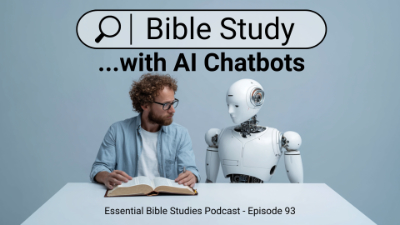
Come and explore with us how artificial intelligence is changing the way we study the Bible. Tim and Nick share their personal stories, practical examples, and thoughtful discussions, as they highlight both the benefits and challenges of using AI tools like ChatGPT, Copilot, and Gemini for research, language learning, and creative projects. The podcast dives into the history of AI, its impact on Bible study, and offers tips for using technology wisely—balancing critical thinking with curiosity. Whether you’re tech-savvy or just starting out, this podcast provides inspiration and practical wisdom for anyone seeking to deepen their Bible study and embrace new ways to learn and connect.
Key Verse:
“If any of you lacks wisdom, let him ask God, who gives generously to all without reproach, and it will be given him.” (James 1:5)
Outline:
Introduction
Background to AI technology
History of AI technology
Attempts to get a computer to think like a human have been going on since the 1950s (Turing test)
Neural Networks, Machine Learning, Large Language Models
Good at matching patterns – images, music, speech… even podcasts
Examples of AI chatbots (OpenAI ChatGPT, Microsoft CoPilot, Google Gemini)
At the time of the end knowledge shall increase – Dan 12:4
Is it good or bad?
Driving force: An increase of knowledge CP the tower of babel (make a name Gen 11:4, people one, nothing restrained they have imagined v6)
Real Intelligence was created by God for his glory. Artificial intelligence was created by man for his glory – Frank Abel
Wisdom of this world is foolishness with God – 1 Cor 3:18-20
The Purpose of Bible Study
To develop a true knowledge and understanding of God’s word
Glory of God to conceal a thing, but the honour of kings to search out a matter – Prov 25:2
To develop ones own mind and character
Test everything, hold fast what is good – 1 Thess 5:21
Limitations and Pitfalls
Shouldn’t let our thinking become automated, we still got to think and put in the work
Lack of Discernment: AI doesn’t believe, it doesn’t distinguish truth from error. Example: Do you believe in God?
“AI can possess vast knowledge, but not wisdom. True wisdom, according to Scripture, begins with the fear of the LORD (Proverbs 9:10) — it is moral, spiritual, and relational, not merely intellectual. Wisdom involves discernment between good and evil, guided by conscience and character, qualities that come from God’s Spirit working in human hearts (Job 32:8; James 3:17).
Artificial intelligence lacks spirit, moral awareness, and reverence for God; it can only process information and imitate understanding. It may be clever, but cleverness is not wisdom. As Paul wrote, “the wisdom of this world is foolishness with God” (1 Corinthians 3:19). AI can analyze Scripture, but it cannot live it — for only a heart taught by God can truly be wise.” ChatGPT
Theological bias – It reflects human bias culled from the Internet. “Many false prophets shall rise and deceive many” Treat it like you would any study reference or human being (1 John 4:1). Example: Personification of the Spirit in Bible translation
Misinterpretation of Scripture: Can make confident-sounding statements but incorrect claims. “AI synthesizes, sorts, and summarizes vast quantities of knowledge in a highly efficient, mind-blowingly fast way in response to a question, problem, or prompt given to it. That’s what it does well. But AI does not create new knowledge” Brett McCracken – Logos (Searches Example: Searching for all Roman surnames
The Positives
Key to creating good prompts and what to expect
Information Retrieval: Quick access to background info, historical context, cross-references, other versions. Example: Was it common for Jews in the 1st century to have Roman surnames?, literal meanings, etymology and possible identity of gemstones in Rev 21:19-20
Searching: Ability to search for ideas rather than just key words Example: “No man knows day nor hour” Matt 24:36, “Jews being hated” “God being thankful” What are some good examples of friends in the Bible?
Summarization & Clarification: Help in understanding complex passages or doctrines. Compare against other denominations. Example: What denominations reject that modern Israel is a fulfilment of Bible prophecy? What passages would they use to support the idea of…”
Language Tools: Parsing original Greek/Hebrew words or analyzing Bible translations. Example: Studying Greek verb tenses for the word “salvation”
Visual demonstrations: Example: New Jerusalem 1500miles cubed
For the kick off of Season 7, we are very pleased to have Jason Hensley joining us. Jason shares the awkward moment that challenged how he read the Bible. This drove him to write a book called “The Bible in Context“. We review the important points of his book and undergo some paradigm shifts along the way. The result is a whole new way of reading the Bible in context.
Key Verse:
“Do your best to present yourself to God as one approved, a worker who has no need to be ashamed, rightly handling the word of truth.” (2 Tim. 2:15)
Outline:
Introduction
Determining Intent
The challenges of interpreting the Bible
The importance of context and the author’s intent (2 Peter 3:15-16 cp. 2 Tim. 2:15) and God’s intent
Recognizing bias and the importance of learning in a community
Historical Content
Cultural, contemporary, geographical
Example of Psa. 121:1
Determining historical context
Literary Content
The immediate verses (Example of Lucifer Isa. 14:12)
Why would you write in your Bible? Marking our Bibles is a great way to make it personal. It helps us to get it into our heart and to have a ready answer. Tim and Josh discuss different types of Bible marking with lots of examples of what they’ve found to be helpful.
Outline
Introduction
What is Bible marking? Why do it?
Wide margin Bibles
Getting into a routine
Why Personalize Your Bible?
Duty of a King to write out the law (Deuteronomy 17:18)
It is about getting it into your heart (Proverbs 7:1-3)
Types of Bible Marking
Identifying words
Love – Agape / Phileo (1 Peter 1:22)
God – El / Elohim
Church – Ecclesia
World – Kosmos / Aion
Character traits of God (Exodus 34:6)
Contextual repetition
Seeing the context (Genesis 11:1-9; Luke 12:16-21; Mark 12:30,33 cp. v.44; Matthew 4:1-10)
Understanding organization and structure (Revelation 1-3; Matthew 5; Zechariah 1-6)
Talk 22 / Class 4 - The Spiritual Habits of the Saints of God (Roger Lewis)
/
RSS Feed
Share
Link
Embed
Class 4: Mastering the Skill of Scriptural Reasoning (Roger Lewis) – Speaker is Roger Lewis at the 2016 Mid-Atlantic Christadelphian Bible School given to a teenage audience.
Talk 22 / Class 2 - The Spiritual Habits of the Saints of God (Roger Lewis)
/
RSS Feed
Share
Link
Embed
Class 2: Building a Strong Bible Study Program (Roger Lewis) – Speaker is Roger Lewis at the 2016 Mid-Atlantic Christadelphian Bible School given to a teenage audience.