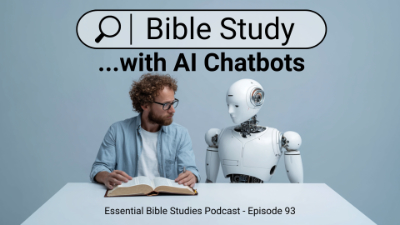
Bible Study with AI Chatbots

Come and explore with us how artificial intelligence is changing the way we study the Bible. Tim and Nick share their personal stories, practical examples, and thoughtful discussions, as they highlight both the benefits and challenges of using AI tools like ChatGPT, Copilot, and Gemini for research, language learning, and creative projects. The podcast dives into the history of AI, its impact on Bible study, and offers tips for using technology wisely—balancing critical thinking with curiosity. Whether you’re tech-savvy or just starting out, this podcast provides inspiration and practical wisdom for anyone seeking to deepen their Bible study and embrace new ways to learn and connect.

Key Verse:

“If any of you lacks wisdom, let him ask God, who gives generously to all without reproach, and it will be given him.” (James 1:5)

Outline:

  1. Introduction
  2. Background to AI technology
    1. History of AI technology
      1. Attempts to get a computer to think like a human have been going on since the 1950s (Turing test)
      2. Neural Networks, Machine Learning, Large Language Models
      3. Good at matching patterns – images, music, speech… even podcasts
      4. Examples of AI chatbots (OpenAI ChatGPT, Microsoft CoPilot, Google Gemini)
    2. At the time of the end knowledge shall increase – Dan 12:4
  3. Is it good or bad?
    1. Driving force: An increase of knowledge CP the tower of babel (make a name Gen 11:4, people one, nothing restrained they have imagined v6)
    2. Real Intelligence was created by God for his glory. Artificial intelligence was created by man for his glory – Frank Abel
    3. Wisdom of this world is foolishness with God – 1 Cor 3:18-20
  4. The Purpose of Bible Study
    1. To develop a true knowledge and understanding of God’s word
    2. Glory of God to conceal a thing, but the honour of kings to search out a matter – Prov 25:2
    3. To develop ones own mind and character
    4. Test everything, hold fast what is good – 1 Thess 5:21 
  5. Limitations and Pitfalls
    1. Shouldn’t let our thinking become automated, we still got to think and put in the work
    2. Lack of Discernment: AI doesn’t believe, it doesn’t distinguish truth from error. Example: Do you believe in God?
      1. “AI can possess vast knowledge, but not wisdom. True wisdom, according to Scripture, begins with the fear of the LORD (Proverbs 9:10) — it is moral, spiritual, and relational, not merely intellectual. Wisdom involves discernment between good and evil, guided by conscience and character, qualities that come from God’s Spirit working in human hearts (Job 32:8; James 3:17).
      2. Artificial intelligence lacks spirit, moral awareness, and reverence for God; it can only process information and imitate understanding. It may be clever, but cleverness is not wisdom. As Paul wrote, “the wisdom of this world is foolishness with God” (1 Corinthians 3:19). AI can analyze Scripture, but it cannot live it — for only a heart taught by God can truly be wise.” ChatGPT
    3. Theological bias – It reflects human bias culled from the Internet. “Many false prophets shall rise and deceive many” Treat it like you would any study reference or human being (1 John 4:1). Example: Personification of the Spirit in Bible translation
    4. Misinterpretation of Scripture: Can make confident-sounding statements but incorrect claims. “AI synthesizes, sorts, and summarizes vast quantities of knowledge in a highly efficient, mind-blowingly fast way in response to a question, problem, or prompt given to it. That’s what it does well. But AI does not create new knowledge” Brett McCracken – Logos (Searches Example: Searching for all Roman surnames
  6. The Positives
    1. Key to creating good prompts and what to expect
    2. Information Retrieval: Quick access to background info, historical context, cross-references, other versions. Example: Was it common for Jews in the 1st century to have Roman surnames?, literal meanings, etymology and possible identity of gemstones in Rev 21:19-20
    3. Searching: Ability to search for ideas rather than just key words Example: “No man knows day nor hour” Matt 24:36, “Jews being hated” “God being thankful” What are some good examples of friends in the Bible?
    4. Summarization & Clarification: Help in understanding complex passages or doctrines. Compare against other denominations. Example: What denominations reject that modern Israel is a fulfilment of Bible prophecy? What passages would they use to support the idea of…”
    5. Language Tools: Parsing original Greek/Hebrew words or analyzing Bible translations. Example: Studying Greek verb tenses for the word “salvation”
    6. Visual demonstrations: Example: New Jerusalem 1500miles cubed
  7. Conclusion

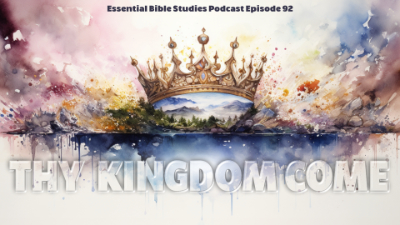
Thy Kingdom Come

On this episode, we step into one of the Bible’s most sweeping storylines—the Kingdom of God. From ancient promises spoken to Israel to the future reign of Jesus on earth, we trace how Scripture builds a unified, unfolding vision of God’s ultimate plan and purpose.

You’ll explore the five essential elements of a kingdom—its king, people, land, capital city, and law—and see how each one anchors Israel’s story and points forward to Christ’s return. Along the way, we highlight the signs Scripture gives for the restoration of God’s reign and why this hope shapes the way we live today.

Key Verse:

After this manner therefore pray ye: Our Father which art in heaven, Hallowed be thy name. Thy kingdom come. Thy will be done in earth, as it is in heaven.” Matthew 6:9-10

Outline:

  1. Introduction
    1. What is the Kingdom of God?
      1. Heaven, where God is
      2. The Church ruling spiritually on earth
      3. The Church ruling in men’s hearts
      4. Jesus Christ ruling on the earth
    2. b. Jesus Bible class on the Kingdom of God (Acts 1:3)
      1. Restoring the Kingdom to Israel (Acts 1:6-7 cp. Acts 3:20-21)
      2. Jesus to come back in like manner (Acts 1:11)
  2. Israel the kingdom of God
    1. The king (1 Chron. 28:4-5)
    2. The subjects (Deut. 7:6)
    3. The land (Lev. 25:23)
    4. The capital (Psa. 132:13-14)
    5. The law (Deut. 5:5)
  3. The future Kingdom
    1. The King (Luke 1:32-33)
    2. The subjects (Ezek. 37:21-24; Psa. 72:11)
    3. The land (Ezek. 37:25; Zech. 14:9; Psa. 72:8)
    4. The capital (Jer. 3:17)
    5. The law (Isa. 2:3)
  4. When will the Kingdom be established?
    1. When Israel is restored (Luke 21:24)
    2. When the world is in trouble (Luke 21:25-26)
    3. When Jesus returns (Luke 21:27,31)
  5. Conclusion

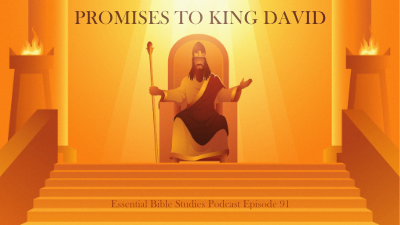
Promises to King David

In this episode Tim Young and Jay Mayock examine God’s covenant with King David, its repeated promise of an eternal throne, and how Jesus is revealed as the promised offspring who confirms and will complete those promises. They trace the theme through Scripture—from 2 Samuel and the Psalms to Matthew, Luke, Acts, and Hebrews—highlighting the resurrection, and the future restoration of God’s kingdom on earth..

Key verse:

“He will be great and will be called the Son of the Most High. And the Lord God will give to him the throne of his father David, and he will reign over the house of Jacob forever, and of his kingdom there will be no end.” (Luke 1:32-33)

Outline:

  1. Introduction
    1. Christ confirmed the promises that God gave the patriarchs – Romans 15:8
    2. Christians share these covenants of promise in Christ – Ephesians 2:12
    3. It is essential to know what these covenants of promise to the patriarchs are.  They were essential teachings OT prophets and NT apostles.
  2. Brief Review of Covenants of Promise to the fathers (patriarchs)
    1. God always had the special offspring (seed) in mind: Christ – Galatians 3:16
    2. Who are the fathers? – Abraham, Isaac, Jacob, his children
    3. David was also a patriarch – Acts 2:29
  3. David’s Covenant of Promise
    1. David promised an offspring who would rule the land of Israel – 1 Chronicles 17:11-14
    2. Psalm about David’s covenant – Psalm 89:3-4, 34-37
    3. Reflections at the end of his life – 2 Samuel 23:5
    4. Solomon on God’s throne over God’s kingdom in God’s land, ruling over the descendants of Abraham, Isaac, and Jacob – 1 Chronicles 28:5, 29:23
  4. War against David’s dynasty
    1. Athaliah’s massacre; Joash survives – 2 Chronicles 22:1-12
    2. Israel-Syrian confederacy; Ahaz survives – Isaiah 7:1-6
    3. King Herod the Great’s massacre; Jesus escapes – Matt. 2:16
    4. Even though it appeared as though the promise had failed, God was still actively working to establish it.  It’s as sure as the sun and the moon.
    5. After so much ruin and overturning of the kingdom, that promised seed will come – Ezekiel 21:27
  5. David’s Covenant of Promise in the NT
    1. Not only are we not surprised to find it there; it had to be there! – Matthew 1:1, 6, 20
    2. It’s there in Zacharias’ song – Luke 1:69-70
    3. It’s there in Gabriel’s gracious words to Mary – Luke 1:32-33
    4. It’s there in Peter’s preaching on Pentecost – Acts 2:30 (13:23)
  6. Until…
    1. He will come back – Acts 3:21
    2. He is the one to whom the throne, the kingdom, and the land all belong


Promises to Abraham (Part 2)

This second part of our study into the promises to Abraham weaves together all the New Testament commentary on this faithful man. First, we see how he never received the promise of the land during his lifetime which necessitates that he be raised from the dead. The scriptures also show Jesus as the true son of Abraham and how believers are the spiritual descendants of the promise. This means we can receive the blessing of forgiveness and the hope to be partakers of the kingdom of God when Jesus reigns on the earth.

The first part of the Promises to Abraham can be found here.

A document with every New Testament passage concerning Abraham can be found here

Key Verse:

“And the Scripture, foreseeing that God would justify the Gentiles by faith, preached the gospel beforehand to Abraham, saying, “In you shall all the nations be blessed.” So then, those who are of faith are blessed along with Abraham, the man of faith.” (Galatians 3:8-9)

Outline:

  1. Introduction
    1. Quick review of the last podcast
    2. Overview of all the NT commentary on Abraham grouped into four categories
  2. The Land
    1. Given no inheritance (Acts 7:2-5)
    2. Sitting in the future kingdom (Matt. 8:11)
    3. The need for resurrection (Matt. 22:32)
    4. They all died in faith (Heb. 11:8-9,13)
  3. The Seed = Jesus
    1. The Genealogy of Jesus (Matt. 1:1-2; Luke 1:33,55,73)
    2. The Spiritual Seed (Matt. 3:9; John 8:33-58; Rom. 9:6-8)
  4. The Blessing of Forgiveness
    1. Peter’s preaching (Acts 3:25-26)
    2. Justified by faith (Gal. 3:6-9)
    3. Baptism into Christ to inherit the promises (Gal. 3:26-29)
  5. The Inheritance by Faith
    1. Heir of the world (Rom. 4:13) by faith (v. 16) and resurrection (v. 17)
    2. Faith and works (James 2:21-23)
  6. Conclusion


Promises to Abraham (Part 1)

Hosts Tim Young and Brian Alexander bring Abraham’s story to life through Genesis, focusing on the recurring promises God makes: an innumerable offspring and a specific land. They cover Abraham’s call from Ur, the name change to Abraham, the covenant ratified in sacrifice, the sign of circumcision, and the faith that led to Isaac’s near-sacrifice.

Highlights include how Abraham’s faith is counted as righteousness, how the promises are reiterated and expanded, and how these events foreshadow the Lord Jesus Christ. Part two will explore New Testament commentary and the fuller fulfillment of these promises.

Key Verse:

“Behold, my covenant is with you, and you shall be the father of a multitude of nations. No longer shall your name be called Abram, but your name shall be Abraham, for I have made you the father of a multitude of nations.” (Gen. 17:4-5)

Outline:

  1. Introduction
    1. The importance of Abraham in the NT
    2. Background story of calling from Ur and being childless
  2. The Initial Promises
    1. The blessing of a seed (Gen. 12:1-3)
    2. The promise of the land (Gen. 12:7)
  3. The Promise Expanded
    1. What he could see (Gen. 13:14-15)
    2. It would be forever (Gen. 13:15)
    3. It would be given to Abram (Gen. 13:17)
  4. The Covenant
    1. Abram’s belief (Gen. 15:5-6)
    2. Covenant by sacrifice (Gen. 15:7-17)
    3. The extent of the land (Gen. 15:18-21)
  5. Circumcision
    1. Name change (Gen. 17:4-6) and promise in past tense
    2. The token of circumcision (Gen. 17:9-14)
    3. The promised son to be through Sarah (Gen. 17:19)
  6. The Sacrifice of Isaac
    1. Abraham obeyed the call to sacrifice his only son (Gen. 22:1-2)
    2. Isaac as a type of Christ
    3. The promises confirmed (Gen. 22:15-18)
  7. Conclusion
    1. The same promises given to Isaac and Jacob
    2. Next podcast on Abraham in the New Testament


Covenants, Oaths and Promises

Welcome to the start of our eighth season! In this episode, we start off with a little word study into covenants, oaths and promises and how to recognize them when God says, “I will”. From there, we trace the hope of eternal life from Eden’s garden to the flood and God’s everlasting covenant with Noah. Explore the difference between unconditional and conditional covenants and see how God’s ultimate plan is to fill the earth with His glory.

Key Verse:

“Paul, a servant of God and an apostle of Jesus Christ, for the sake of the faith of God’s elect and their knowledge of the truth, which accords with godliness, in hope of eternal life, which God, who never lies, promised before the ages began.” (Titus 1:1-2)

Links to Past Episodes:

 The Memorial Name Yahweh

In the Image and Likeness of God Part1 and Part 2

Outline:

  1. Introduction
    1. The promise of eternal life from the beginning (before the ages began, Titus 1:2). Must come from the Old Testament.
    2. Critical part of the gospel (Acts 26:6-8)
    3. The idea and importance of promises, oaths, testaments and covenants
      1. Covenant
      2. Oath / Swear / “as truly as I live”
      3. Promise / “I will”
  2. Eden
    1. Gen. 1:26-28 God’s original purpose for mankind to have dominion over the earth (cp. Isa. 45:18)
    2. Gen. 3:15 The promise (“I will…”) of a saviour to defeat sin
  3. Noah and the Flood
    1. The corruption of the earth and God’s judgement (Gen. 6:5-8,17-18)
    2. Repeat of creation (Gen. 9:1-3) and echo back to Gen. 1:26-28
    3. The everlasting covenant not to destroy the earth (Gen. 9:9-17). Covenant mentioned seven times.
  4. God’s Eternal Promise
    1. Unconditional (everlasting) vs conditional covenants (the law of Moses Ex. 19:5-6)
    2. God’s ultimate promise to fill the earth with his glory (Num. 14:21)
  5. Conclusion
    1. The importance of understanding the covenants (Eph. 2:12) and what was promised
    2. Episodes to follow on Abraham and David


Testimony and Reflections Season 7

George had a good life in Trinidad until one night in a drunken stupor he killed someone. Sentenced to death, he turned to the Bible for answers and God called him from his prison cell. Thirty-two and half years later George joins us to reflect on his life, give thanks and offer advice for young people.

Key Verse:

“Those who heard it said, “Then who can be saved?” But he said, “What is impossible with man is possible with God.”” (Luke 18:26-27)

Casting Out Demons

This is the second part of our study on demons. The Gospel records of Matthew, Mark and Luke are filled with stories of Jesus casting out demons. This is in contrast with the rest of the Bible where it is not mentioned. Richard joins Tim to discuss the history between the Testaments and why this should be. They then turn their attention to the parables of Jesus and show how he made the demon-idol connection in his parables and healings. As an example, we consider the case of the Gadarene demoniac Legion and how he reflected the nation of Israel.

The first part of our demon study is here https://essentialbiblestudies.podbean.com/e/demons-idols-and-superstition/

Key Verse:

“And they came to Jesus and saw the demon-possessed man, the one who had had the legion, sitting there, clothed and in his right mind, and they were afraid.” (Mark 5:15)

Outline:

Introduction

  • Review of last podcast: the idol-demon connection
  • But why the sudden demonology of the Synoptic Gospels?

A short history of the time between the testaments

Demon miracles as parables

  • Jesus’ ministry of parables (Matt. 13:34-35; Mark 3:22-23)
  • The parable of the seven evil spirits (Matt. 12:43-45) is about that “evil generation”
  • The Gadarene demoniac as a parable of Israel (Mark 5)
    • Among the tombs eating swine’s flesh (Isa. 65:2-5)
    • Always in the mountains crying and cutting himself (1 Kings 18:28)
    • Bound with fetters and chains like Israel’s captivity (e.g. 2 Kings 25:7)
    • Pigs (unclean animal) drowned in the depths (Micah 7:19) and then sitting in his right mind (the final healing of Israel Zech 13:2)
  • The language of casting out demons the same used of natural illness (Luke 4:35,38)

Conclusion – God is more powerful than demons

Cover Art:

Old Babylonian plaque showing seven demons and Lamashtu, a feared female demon.

https://collections.louvre.fr/en/ark:/53355/cl010120468

Demons, Idols and Superstition

We begin a two-part study on demons by making the key discovery of the connection between demons and idols. The Bible frequently states that an idol is  nothing and cannot do either good or bad. Does this mean that demons are nothing, that it is mere superstition, and that God is truly sovereign? Join Richard and Tim as they delve into this essential Bible study.

Key Verse:

“They stirred him to jealousy with strange gods; with abominations they provoked him to anger. They sacrificed to demons that were no gods, to gods they had never known, to new gods that had come recently, whom your fathers had never dreaded.” (Deu 32:16-17)

Outline:

Introduction

  • Online debate (1997) with Anthony Buzzard / COGAF
  • Claims of modern-day demon experiences but what does the Bible teach?
  • Words for demons (Gk. diamonia – Heb. shed meaning destroyer and satyr meaning goat idol)

Demons in the Old Testament

  • Psalms106:34-38 there is a connection between demons and idols
  • Idols are nothing (Psa. 135:15-18; 96:4-5; Isa. 65:3 LXX)
  • Deut. 32:16-17, 39 (Lev. 17:7). God is in charge of everything which they associated with demons (Deut. 28:27-28, 58-61).
  • Because of this we are not to be afraid, they cannot do evil (Jer. 10:2-6, 14-15)

The Demon Idol Connection in the New Testament

  • 1 Cor. 10:18-22 (cp. 8:4-6) Paul’s association of idols with demons and their being nothing
  • Acts 17 – Paul’s tour of Athens
    • V. 18 foreign divinities = daimonion
    • V. 22 very religious = Deisidaimoni = fear of demons
    • V. 24-26 God is sovereign

Conclusion on Superstition

Cover Art:

Statue of the demon Pazuzu (about 934-610 B.C.) at the Louvre Museum.

https://collections.louvre.fr/en/ark:/53355/cl010120489

Follow us on…

Facebook: https://www.facebook.com/essentialbiblestudies

Instagram: https://www.instagram.com/essentialbiblestudies/

X: https://x.com/bible_podcast

Get it…

Get an invite to our Tuesday night Bible Studies at essentialbiblestudies.org

Request a free Essential Bible Studies media kit